

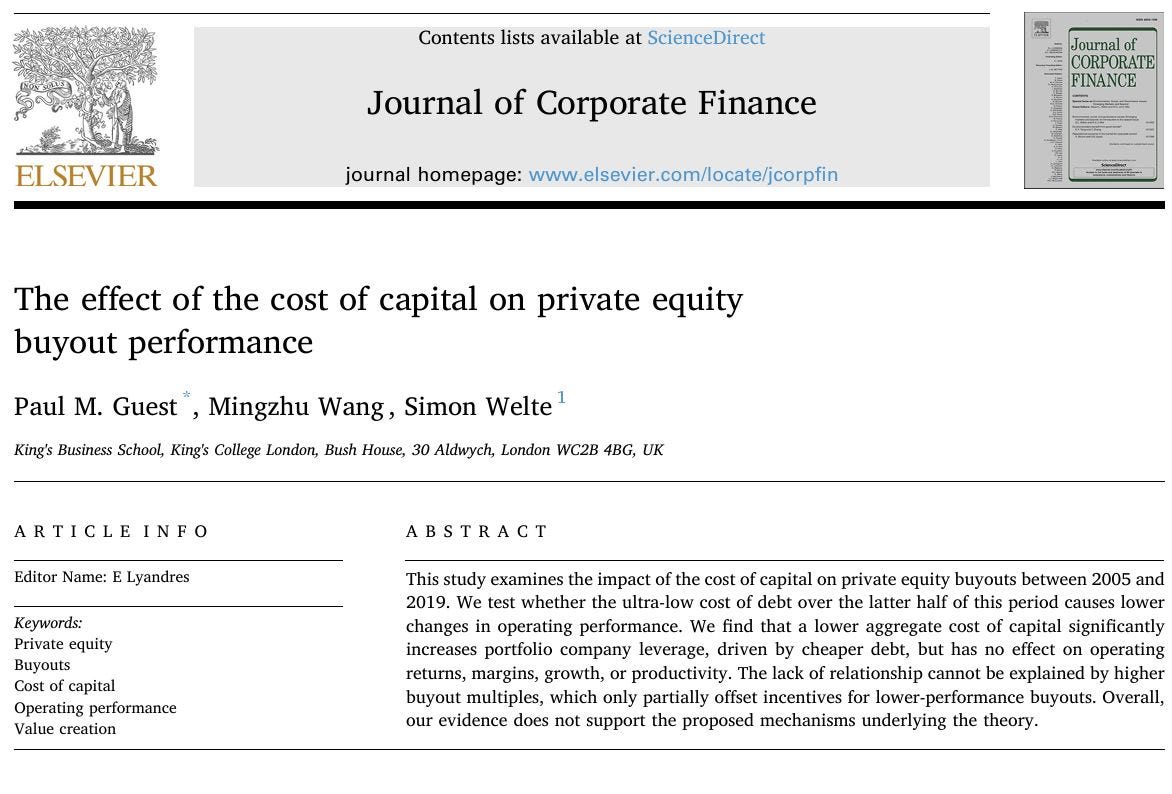
The narrative that the period of ultra-low interest rates made life easy for private equity managers is both popular and intuitive:
▶️ Previously, the argument goes, PE managers had to rely more heavily on operational improvement, growth initiatives and cost discipline. In the era of ultra-low interest rates, they could simply lever up on cheap debt to generate attractive returns instead.
▶️In the paper, Paul M. Guest (King’s College London) and co-authors use a sample of 1072 UK buyouts completed in the 2005-2019 period to test empirically whether this narrative holds (the combination of an active PE market and mandatory financial disclosures make the UK a good test environment).
The results are certainly interesting:
✅ A lower aggregate cost of capital significantly increases portfolio company leverage, driven by cheaper debt.
❌ However, the authors find no effect on operating returns, margins, growth, or productivity.
From a practitioner perspective, this seems relevant to me for a few reasons:
1️⃣ It is reassuring as it suggests that the operational skillsets that LPs want to see do not have to be re-learned, they were still actively in use even in the very benign market conditions of the lower interest rate era.
2️⃣ The idea of a post-cheap-money “hangover” may be more nuanced than some suggests. Around one third of the sample had not yet been exited as at the time of the analysis, so the final verdict is still open, but if low-rate-era deals were still accompanied by operational improvements, rather than relying solely on cheaper financing, this may provide at least some resilience when rates rise.
Much more information and many more useful insights in the paper itself; well worth a read for those academically inclined.
Note: All errors are my own; I am in no way associated with the paper.